

No hay productos en el carrito
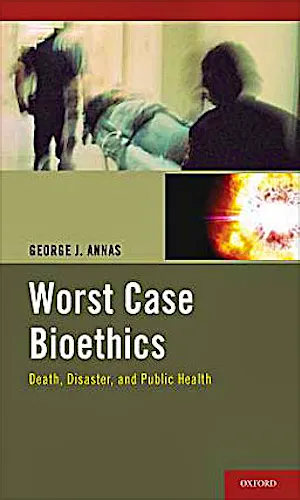
Worst Case Bioethics. Death, Disaster, and Public Health
Annas, G.J.
1ª Edición Abril 2010
Inglés
Tapa dura
360 pags
1200 gr
16 x 24 x null cm
ISBN 9780195391732
Editorial OXFORD USA
LIBRO IMPRESO

-5%
35,18 €33,42 €IVA incluido
33,83 €32,13 €IVA no incluido
Recíbelo en un plazo de
2 - 3 semanas
ABOUT THIS BOOK
- Explores the current debates on global medical issues including national health care, experimental cancer drugs, quality of medicine and patient safety, preparation for a global flu pandemic, and regulating/outlawing cloning and germline genetic alterations.
- Synthesizes bioethics, constitutional law, and international human rights law to help explain the uses and abuses of worst case scenario reasoning in contemporary bioethics and public health debates.
- Addresses national security issues concerning current national policies such as the best response to bioterrorism, force-feeding hunger strikers at Guantanamo, killing civilians in Afghanistan, with an emphasis on the roles played by physicians and lawyers in each.
Bioethics, still in its infancy, is routinely called on by the government to provide political cover for controversial public health decisions involving the life and death of Americans. Doomsday or worst-case scenarios are often at the heart of these biopolitical decisions. A central feature of science fiction, these scenarios can impart useful insights. But worst-case scenarios, like Frankenstein's monster, can also be unpredictably destructive, undermining both preparedness and the very values bioethics seeks to promote. Discovering a new flu strain, for example, leads immediately to visions of the 1918 flu pandemic, the worst in human history. Likewise, a "ticking time bomb" scenario leads to the use of the "saving lives" rationale that permits lawyers to justify it and physicians to carry it out.
The worst case charge of "death panels" continues to threaten meaningful healthcare reform in the US. Fundamental change in American healthcare, Annas argues, will require fundamental change in American, including confronting our obsession with technology and our denial of death, and replacing our over-reliance on the military and market metaphors in medicine. "A combination of the ecological and rights metaphors could help us successfully navigate the waters of change."
In Worst Case Bioethics, George Annas employs contemporary disputes involving death and disaster to explore the radical changes underway in public health practice, the application of constitutional law to medicine, and human rights discourse to promote human health and wellbeing. Worst-case scenarios, especially worst-case bioethics scenarios, distort debate, limit options, rationalize human rights abuses, and undermine equality and social justice. It is, nonetheless, possible to temper worst-case scenarios in ways that promote both the development of a meaningful American bioethics, and a life and liberty affirming global health and human rights movement.
Written at the intersection of law, bioethics, public health, and human rights, Worst Case Bioethics will interest not only bioethicists but scholars in public health, public policy, and human rights law, as well as members of the public who want to participate in these policy debates.
Readership: Professors and students of bioethics, human rights, law, medicine, and health law. Also, public health professionals and NGOS, government official and legislators, global public health readers, and human rights advocates.
AUTHOR INFORMATION
George J. Annas, Professor & Chair, Boston University School of Public Health
REVIEWS
"Annas persuasively argues in Worst Case Bioethics that basing policy on extreme nightmare possibilities leads to a distortion of fundamental ethical principles and legal protections." - Lancet
"Most readers interested in these topics will find this a creative and insightful rubric for examining different aspects of U.S. healthcare and law." - Dr R MacDougall, Saint Louis University

© 2026 Axón Librería S.L.
2.150.1