

There are no products in the cart.
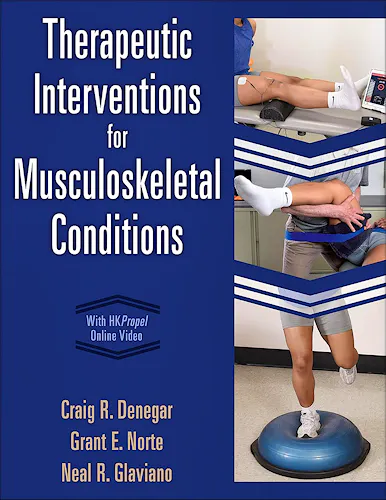
Therapeutic Interventions for Musculoskeletal Conditions
Denegar, C. — Norte, G.
1ª Edition February 2026
English
Soft Cover
352 pags
990 gr
22 x 28 x 2 cm
ISBN 9781718230934
Publisher HUMAN KINETICS BOOKS
Printed Book

-5%
118,00 €112,10 €VAT included
113,46 €107,79 €VAT not included
Receive it within
2 - 3 weeks
Description
Therapeutic Interventions for Musculoskeletal Conditions With HKPropel Online Video offers a modern, patient-centered approach to managing musculoskeletal injuries and conditions. Going beyond isolated modalities, it presents a multimodal perspective that integrates physical agents, manual therapy, and therapeutic exercise for comprehensive rehabilitation.
This updated edition includes full-color illustrations explaining neurophysiological and biomechanical mechanisms, as well as 24 online videos demonstrating the application of evidence-based interventions. A progressive case study runs through all parts of the book, guiding readers from initial assessment to advanced rehabilitation strategies and helping them understand how to integrate and adapt interventions over time.
Table of Contents
- Part I. Clinical Reasoning
- Chapter 1. Patient Examination and Evaluation
- Defining the Problem
- The Diagnostic Process
- Biopsychosocial Models of Health
- Patient Self-Report Instruments
- Psychological Considerations in Musculoskeletal Care
- Summary
- Chapter 2. Developing the Plan of Care
- Clinical Decision Making
- Steps in Developing the Plan of Care
- Goal Setting With the SMART Framework
- Selecting the Appropriate Intervention
- Documentation when Developing a Plan of Care
- Summary
- Chapter 1. Patient Examination and Evaluation
- Part II. Pain
- Chapter 3. Pain Transmission, Sensation, and Signal Modulation
- The Pain Experience
- Acute, Persisting, or Chronic Pain
- Peripheral Sensory Receptors and Nociception
- Afferent Nerves and Pain Signal Transmission
- Pathways for Transmission of Nociceptive Pain
- Sensory Integration
- Pain Signal Modulation
- Summary
- Chapter 4. Tissue Injury, Inflammation, Nociception, and Healing
- Tissue and Injury
- Immediate Response to Injury
- Inflammation
- Triggering Nociceptive Pain and Initiating Repair
- Tissue-Specific Healing
- Factors Influencing Tissue Healing
- Summary
- Chapter 5. Pain Science and Patient Education
- Nociplasticity and Sensitization
- Explaining Pain
- Summary
- Chapter 6. Clinical Management of Pain
- Cold
- Superficial Heating
- Transcutaneous Electrical Nerve Stimulation (TENS)
- Manual Therapies
- Therapeutic Ultrasound
- LASER
- Summary
- Chapter 7. Pain Management and Exercise
- Exercise Recommendations and Medical Exercise Therapy
- Exercise and Pathological Pain
- Exercise Prescription Considerations
- Components of Exercise Prescription
- Tips for Prescribing Exercise
- Summary
- Chapter 3. Pain Transmission, Sensation, and Signal Modulation
- Part III. Restoring Motion
- Chapter 8. Impaired Range of Motion
- Causes of Impaired Motion
- Hypomobility, Joint Health, and Biomechanics
- Plan of Care for Motion Restrictions
- Summary
- Chapter 9. Manual Therapies
- Informed Consent, Contraindications, and Precautions
- Positioning and Soft Tissue Techniques
- Clinical Decisions in Positional and Soft-Tissue Techniques
- Joint Mobilization
- Clinical Decisions in Joint Mobilization Techniques
- Exercise
- Summary
- Chapter 10. Facilitating Motion With Therapeutic Modalities
- Superficial Heat
- Therapeutic Ultrasound
- Diathermy
- Traction
- Summary
- Chapter 8. Impaired Range of Motion
- Part IV. Neuromuscular Control
- Chapter 11. Muscle Weakness, Atrophy, and Neuromuscular Impairment
- Origins of Muscle Weakness
- Origins of Muscle Atrophy
- Origins of Impaired Proprioception and Neuromuscular Control
- Summary
- Chapter 12. Therapeutic Modalities to Facilitate the Restoration of Strength and Neuromuscular Function
- Therapeutic Adjuncts to Exercise
- Focal Joint Cooling
- Transcutaneous Electrical Nerve Stimulation
- Neuromuscular Electrical Stimulation
- Blood Flow Restriction
- Biofeedback
- Vibration Therapy
- Timing Considerations
- Summary
- Chapter 13. Exercise Prescription to Improve Strength and Neuromuscular Control
- Avoiding Common Misconceptions in Therapeutic Exercise Programming
- Contemporary Therapeutic Considerations
- Emerging Therapeutic Considerations
- Integration and Maintenance of the Plan of Care
- Summary
- Chapter 11. Muscle Weakness, Atrophy, and Neuromuscular Impairment
- Part V. Repair and Mechanobiology
- Chapter 14. Mechanical Signaling and Tissue Homeostasis
- Foundational Principles and Mechanisms of Mechanobiology
- Mechanobiology in Musculoskeletal Tissues
- Summary
- Chapter 15. Exercise and Therapeutic Modalities as Stimuli for Tissue Repair
- Tissue Specific Loading Considerations
- Therapeutic Modalities
- Summary
- Chapter 14. Mechanical Signaling and Tissue Homeostasis
Audience
Graduate students in athletic training and physical therapy, as well as rehabilitation professionals seeking to integrate evidence-based and multimodal therapeutic interventions for musculoskeletal care.
Description
Therapeutic Interventions for Musculoskeletal Conditions With HKPropel Online Video presents a modern, patient-focused approach to musculoskeletal rehabilitation that goes beyond isolated modalities to deliver truly integrated care. This multimodal perspective emphasizes how and why physical agents, manual therapies, and therapeutic exercises should be applied to optimize each patient’s plan of care.
The book provides a comprehensive understanding of treatment options and their physiological and neurophysiological implications. Full-color medical illustrations depict joint mechanoreceptors, pain transmission pathways, and physiological responses to various interventions. Additionally, readers have access to 24 online videos demonstrating the practical application of evidence-based therapeutic interventions, including physical agents, manual therapy, and neuromuscular reeducation.
A unique feature of the text is its cumulative case study, which progresses throughout the five parts of the book—from the initial evaluation and plan of care to the implementation and progression of therapeutic techniques. This structure helps students understand how interventions are integrated and advanced over the course of patient recovery.
Table of Contents
- Part I: Initial evaluation and creation of a plan of care
- Part II: Neurophysiology of pain transmission, signal modulation, tissue injury, inflammation, and pain science
- Part III: Range of motion limitations and therapeutic modalities and manual interventions used to restore motion
- Part IV: Importance of neuromuscular control in the healing process and techniques to facilitate recovery
- Part V: Mechanical signaling and the role of exercise in tissue recovery
The book helps students and professionals develop clinical reasoning and decision-making skills for choosing the safest and most effective therapeutic interventions.
Audience
Graduate students in athletic training and physical therapy, as well as rehabilitation professionals seeking an evidence-based, patient-centered approach to musculoskeletal care.

© 2026 Axón Librería S.L.
2.150.1